Tuesday, January 03, 2006
New
discussion about signal pathways
and complex ontology
This is part of a discussion that will be moved to a Wiki page soon.
The leafs of the hierarchy under the physicalEnitity (class) are specified under the disjoint union of the four subclasses of physicalEnitity; complex, protein, rna, smallMolecule.
Side comment: I am trying to see what OWL full allows and how the BioPAX group has used OWL full. Getting language correct here is important, so if I say something odd it is because I am not using language correct as yet.
Because my personal knowledge is incomplete and because there are really different viewpoints about ontological modeling, some of the things I am saying below may not be well said or even accurate
The "PARTICIPANTS" property (for reference, please use Protege and the biopax-level1 OWL file to see the specification of this property). In the comments the property is called a "slot".
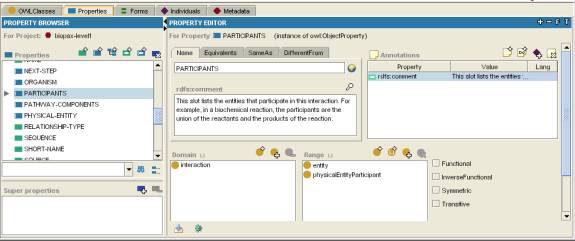
The concept of slot was originally developed in a knowledge representation school different (in specific ways) from the OWL viewpoint. OWL properties are defined as a function with domain a set of classes and range a set of classes. For example, in the figure above, the domain of “property” of being a participant is the class “interaction”. The range is both entity and physicalEnityParticipant. The mechanics of how functions are used is tied to two basic features of OWL ..
1) retrieval of data as in a relational database
2) the use of some features of set theory and logic to produce a “binding together of data” that is encoded as “instances” in the Protégé backend.
Some folks call #2 and even #1 “reasoning with ontology”, but others prefer to see the results of query as not exactly “reasoning” in the same sense of humans reason about where to go to eat supper. For convenience, however, we will sometimes use the term “reasoning system” to refer to Racer or one of the other computer programs that the developers have termed “ reasoning systems”. We do this to avoid issues while attempting to remember the differences between community context for these terms.
In the figure 1 above, one can see that there are no slot tags in OWL; but if you use basic Protege (without the OWL plugin) one sees the slots as something in the API design. In Protege Basic there is a class editor with "template slots". "Facets" is also a label on the Basic Protege interface, as well as "constraints", and "roles".
I have been trying to trace the history of the use of these terms back, but am still confused because at one point I thought Protégé was designed to use the KIF (Knowledge Interchange Format). The histories of these things are hard to follow.
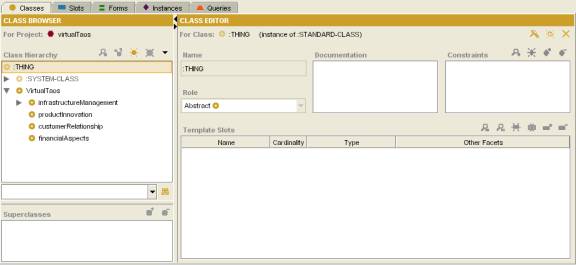
In my understanding of Schank (frames slots and fillers), the BioPAX group agreement that a comment on a property should be thought of as a slot implies that there is a context (a frame) in which this property is used, thus the slot terminology.
The context captured here in the BioPax level 1 "data ontology" is that the frame is "an interaction" thus the domain of the property PARTICIPANTS is only the interaction.
In a layered ontology the participants in an interaction may also be a frame were the context is at the level in which the participant is seen as a category (ie all instances are the same), but where there are differences such as conformational details, catalytic bindings, and active or passive roles in indirect pathways, or even non-local causation (if that exists).
One key in creating a full understanding of cell, or gene, expression is in seeing how organizational layers might come into existence. In the literature on complex systems and thermodynamics, there is the notion of pi numbers where physical organizational properties result is interesting numbers like Plank’s constant. In biology there might be “inheritance” where the organization scales assume structure due to the layering of reaction chains, such as signal pathways. This is the conjecture I am most interested in.
I will stop here for comments.
Paul Prueitt