Sunday, February 20, 2005
National Debate Thread
BCNGroup Evaluation of
CoreSystem
On the Nature of science and
cultural Polemics à
On the discussion of data
regularity à
On the Stephenson Cyber Attack
Taxonomy à
(Download a 10 meg zipped
Macromedia presentation on CoreSystem.) à
The following is communicated by Sandy Klausner.
John (Sowa),
You asked, what is new in CoreSystem design?
Very briefly and just addressing the diagram you referred to in your recent email:
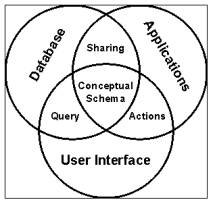
From Sowa (1973)
This diagram does not reflect the depth and breath of the CoreSystem architecture.
A few points are worth noting.
Database
Context computing uses a unified data model that subsumes the file, relational, object, and XML schemas providing a combined network/composite view that is fully distributed across the network.
It eliminates the impedance mismatch between dynamic and persistent elements and greatly simplifies general systems modeling.
In fact the iconic designs are directly executable without ever resorting to code no matter what domain, whether from Web services to real time embedded processes.
One does not even think in terms of a "database", a system’s elements can just be made persistent.
These qualities are in no way anticipated by your diagram.
Applications
The "application" term does not exist in the Cubicon vocabulary. All systems are composed of a finite set of "core" objects.
Paul tells me that this is very "Peircean" in nature, and is related to his notion of ontological stratification between primes and compounds.
Cubicon enables true component reuse because language theories are embedded all the way down into bit-exact virtual machine architecture.
Different communities can browse components by ontology and with permission incorporate disparate components into their local systems. Therefore, the packaging mechanism is objects in modules, modules in frameworks, and frameworks executing on virtual machines.
Again, your 1973 diagram in no way anticipates the innovation.
User Interface
Since the dawn of the computer industry we have had two classes; programmers and users.
Programmers create walled applications where we still struggle to move data, yet also deal with real-time application interaction. Applications become bloated with parameters in an attempt to deal with all user contingencies. There is over design that is costly.
At some level of abstraction there is a cliff where the professional programmer must be called in to modify the "code".
Cubicon eliminates this two-class barrier. A system developed in Cubicon is approachable by users trained in the expression medium. The CoreSystem environment provides extensive automation that is completely syntax-driven and semantically bound. This means that a much broader segment of the growing knowledge worker population will be able to participate in system creation and evolution.
These comments are just the tip of the iceberg of disclosure of this seminal technology. I would be pleased to answer additional inquiries.