Monday, April 25, 2005
On the discussion of data
regularity à
On the Stephenson Cyber Attack
Taxonomy à
Discussion about frameworks: the role that Subject Matter Indicator Covers play
Modified from April 21.
Saturday, April 23, 2005
A Subject Matter Indicator (SMI)
“points at a concept” as a part of a natural “language game” in the sense of
later Wittgenstein. (etc, etc… a
discussion can go off here about this, or one simply already understand that
Wittgenstein was originally a “logical positivist” and then he changed to
“linguistic realism” (my term derived from Pribram’s use of the phase
“scientific realism”.) Tom Adi’s
structural ontology is another example of linguistic realism.
Adi Structural Ontology Part I
The key concept was present
in the KIF (Knowledge Interchange Format) that preceded the OWL standard. This key is that a “frame” has slots that
can be filled. If the slots have a stable
set of realizations and the fillers, e.g., those natural to a large class of
instances, are all known then the set of “observed” fillers can be clustered
into categorical abstractions. This
clustering is similar to the creation of a set of categoricalAbstraction (cA)
atoms underlying the set of natural causes to real event structure (the
“stratified hypothesis”).
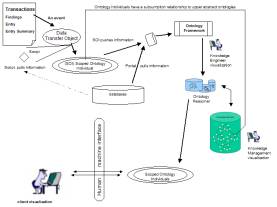 If a cA set is known, then we have the two sides to
the differential ontology framework.
The semantic extraction [1]
(expansion and contraction [2]
) is produces known “locations” in text where SMI are said to be present. This is an imprecise measurement of meaning
(as it should be). The explicit
ontology is the other side to DOF and stands there reifying the semantic
extraction process, and supporting semantic expansion and semantic compression
algorithms. The explicit ontology is
visualizable (using our RDF editor) and can be changed in real time by
individual humans. The changes in
ontology is not, as the First School of Semantic Science would have us believe,
a “standardization” process, but one which we govern through the use of the
SchemaLogic Inc SchemaServer COTS product used over various diverse community
of practice rooted controlled vocabularies and taxonomy.
The management of a diverse
social discourse is why the BCNGroup Roadmap for semantic technology adoption
requires the use of the SchemaServer product.
(Cubicon would work here also, but Cubicon expressions about data
regularity in context are years away from being available). RosettaNet attempted to provide this
function and failed. Various “pattern
language” discussions are going on in blogs and eforums and can be harvested
into a representation of these discussions (by the way).
Ok, so that is the advanced
knowledge management issue.
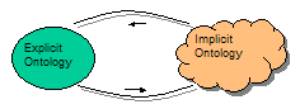 Back to the technical issues related to cA sets. The concept is that a frame could have a
standard set of slots, to be filled with a controlled vocabulary – mapped to an
actual explicit ontology (set of concepts).
The semantic extraction process uses the explicit ontology as a
reification device and the explicit ontology uses the semantic extraction
process as a measurement device.
As a matter of practical
experience, the set of fillers for each slot might become complete after a
period of time. This “completion” is
contextual. The slots are filled
according to some affordance structure/function double articulation (again the
“stratified conjecture”.)
Differential ontology
framework requires the possibility of the filler set opening up to some few new
elements if the context over which measurement is occurring has changed. This is because the “affordance structure”
present with the contextual situation has changed. Each affordance, if this notion can be localized, expresses as a
subject indicator and thus a specific sign, or filler, is usefully assigned to
that affordance.
If the project is not real
and the data is not real then the empirical process required to demonstrate
differential ontology framework is simply not available and nothing of value
will be seen. This is a critical
requirement, based on pragmatics and the theoretical view that data regularity
is real but if not treated as real, cannot be seen. This fact has been one of the primary barriers to establishing
the first instance of ontology mediated information flow (in real communities
in real time). [3]
The filler set having been
collapsed into a categorical cover (set of cA atoms) is what is necessary to
understand what we have asked Tom Adi to create and express as either 19 tuples
(in the full e-SOF) or a 7 tuple (in the reduced e-SOF).
Assertion: The slots are
categories of “measurement” and the fillers are types measured within a
specific category. (We will return to
this assertion in a minute.)
In the full e-SOF we have
18 questions formed by a synthesis of three dimensions:
{
how , why }
{
person, place, thing }
{
past, present, future }
So any one of the 18 elements of the formal set-theoretic cross-product has the form:
( x, y , z )
where x is a how or a why; y is a person, place or thing; and z is a condition as being past, present or future.
Example: ( how this person did something in the past ).
Tom and Pat Adi and I had a
discussion about how really hard this was to instrument in a semantic
extraction process. Once the first e-SOF instrumentation is done; however, a
methodology can be seen and used to make this process of producing situational
instruments more understandable. We may
find that the use of VisualText is essential and critical to this
generalization.
So we simplified by taking away the third dimension to now only the reduced e-SOF with 6 question types.
{ (how, person), (how, place), (how, thing), (why, person), (why, place), (why, thing) }
so for each event we have a 7 tuple
( a0, a1, a2, a3, a4, a5, a6 )
with either the slot filled or not. The first element in the ordered set is a0, and this is used to place the name of the event / document.
Example (WITHOUT A CATEGORICAL COLLAPSE):
{ Tom worked hard to achieve the task, (blank), (blank), Tom was motivated to achieve the result, Tom worked in his home because his home was comfortable, (blank) }
The “filler” “Tom worked
hard to achieve the task” is found in Readware probes by the measurement of the
co-occurrence of Adi stems. In my made
up example, I can not tell anyone what the stems might be. Our hoped for real example on the Harmonized
Tariff Schedule administrative rulings is at:
When this example is completed, we will be able to see what actual stems where actually involved as computational “probes” examines a specific administrative ruling. At this point, the proof of concept will be there for all to see objectively.
 Let
us go back to the assertion that “The slots are categories of “measurement” and
the fillers are types measured within that category.”
The theory we have been discussing suggest that if one automatically makes responses to each of the 6 categories of questions, that the algorithms will force a collapse into regularity governed by contextualization.
Let is look at an example. We have 10,574 documents in our test collection. The 4th question (why, person) might get answered in only 2,000 of these, whereas the 3rd question (how, thing) night get answered in 9,000 of these (due to the nature of the administrative rulings we are dealing with).
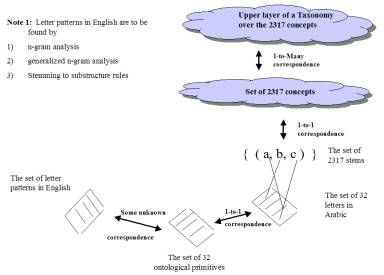
We make the following prediction. Of the 2,000 there will be a smaller number of categories, of “subjects”, that the subject matter indicator responses will fall into. How “ responses are formed “ is critical. In the Readware semantic extraction process, we know that there is a great deal of underlying regularity due to a generative process that comes from a theory of ontology primes [5]. The response might be only the stems related to the Readware semantic extraction process; let us assume that there are 2,317 stems. The number of stems actually used depends on user-defined parameters. The actual set of stems used in an examination of the Constitution is a different set that the set of stems used to examine a Presidential address to the Nation.
Specific data regularity in context is what is being sought. If we insert into the slot a stem that is “indicating”, or from which one might conjecture, that one of the question categories is being addressed; then we would not expect to get more than 500 out of the 2,000 occurrences to be unique. Likewise we would not expect to get more than say 700 out of the 9,000. We understand that a specific stem occurring in the 4th slot and also in a 3rd slot (in some other document) would have a different contextualization.
So now let us look at the co-occurrence, of slot values, between the 3rd and the 4th slots.
Out of all 10,574 documents we might have 65 which have both the 3rd and the 4th slots filled. In these 65, we might have ten that matched exactly; and thus we would have a conjecture that the matched answers had a meaning that was being repeated over the “event space”. In these 65 we might also have 5 other matches where more than once a specific stem in slot 3 matched with a specific stem occurrence in slot 4. In this case we would conjecture that we have 6 patterns that are meaningful.
A human-center visualization of these patterns will see the meaning and as a result some new explicit ontology can be created using differential ontology framework. Once this is done, one can instrument more finely for that particular pattern, using standard entity extraction methods.
Other co-occurrence would be found in other slot pairs, and in patterns where three of perhaps even four slots are involved.
We have to see how this works out.
Issue. More than one stem is used in “indicating” a subject matter in the Readware probes. So one needs to deal with this issue eventually. At first – to demonstrate the theory’s feasibility one might place only two stems or one stem in the fillers and see what happens.
However, regularity of patterns in measured reality is more powerful than one might expect. If we say that a stem 2-tuple as to be reported, because Readware uses stem frames that have three elements, we would have
2,317 *2,317 = 5,368,489 possibilities
But if we let the
algorithms work we will not get 10,574, one for each document, of these
randomly. We will get perhaps only
1,500 - 3,000, and we will find co-occurrence patterns. This is an empirical statement and has to be
verified. One can be skeptical here,
but this does no good if we cannot run the experiments.