Generative
Methodology for Computation Semiotics
Authored by Paul Stephen Prueitt, PhD
Version 5/6/2005 9:37 AM
For: the book “Computational
Semiotics”
In press (2005)
Edited by
Ricardo Ribeiro Gudwin
Section 1: Preliminary notes
An architecture
outlined is developed from a mixture of complex systems theory and knowledge
representation theory. A principled
grounding in the natural sciences differentiates this work from most other
Semantic Web work. It is with respect
and appreciation that we identify an alternative to the Semantic Web and
Artificial Intelligence, as classically envisioned by scholars like Jim Hendler
[1]. We call the alternative the Second School of
Semantic Science and contrast this with the First School of Semantic
Science.
The second
school is suggesting a new information paradigm that is human centric. Members of a civil community localize
ontology situationally. This is done,
as it is now, as part of everyday activity.
The second school brings a simple technology to these everyday
activities. Using this technology [2]
members of a community are allowed to encode new pieces of ontology, a
representation of reality via a set of concepts, into bit patterns that are
compact and easily manipulated. The
manipulation and definition of ontology is done via an iconic user interface
language those elements correspond to the invariance of experience as realized
by humans. The role of the computer
scientist is diminished. The role of
cognitive science and knowledge management is increased.
A new
technology creates a means to measure the presence of delineated concepts using
subject matter indicators, such as the presence of word, stem or word phrase
co-occurrence patterns. Some regard
this as a generalized n-gram analysis [3]
and we agree. The result is not merely
the establishment of a set of subject matter indicators found via, what is now
called, semantic extraction. The result
is computational semiotics, where the notion of semiotics is a notion that is
referring to a system of signs. The
signs develop from a complex interaction between advanced knowledge management
technology and normal everyday activities.
Humans develop the sign system in a way similar to how geometry and
arithmetic was developed historically.
The primary difference is that with ontology development the abstraction
is more situationally focused on phenomenon that is complex, such as decisions
with uncertainty or informational incompleteness.
The second
school refers to most current “semantic extraction” as a syntagmatic
extraction, since a structural pattern is found. The certainty of formalism like geometry and arithmetic is found
in the measurement of these structural patterns. There is no ambiguity in this measurement. The measurement presents to human visual
inspection signs or symbols that evoke meaningful mental experiences.
A human
experiences meaning. The extraction
processes is not “from a human” but rather from the organization of words in
text. We hold that when we misuse
language, use the word “semantic” when we really should use the term
“structure”, then we diminish the quality of the technology that is
produced. The second school finds
bypasses to specific hard problems which have blocked success in technology
developed from the first school’s assumptions.
The anticipatory
architecture uses syntagmatic expansion and contraction mechanisms to tease out
the response patterns that are anticipatory of behavioral state transitions
made by individual, economic and social systems. Meaning is not merely found in context. Meaning is part of an experiential process
that involves mental state transitions and complex non-deterministic human response
mechanisms.
Our principle technical
innovation has to do with a separation of the substance of information into two
types of ingredients. Our formalization
of this separation is inspired by a study of cognitive neuroscience and related
scientific domains like immunological theory. The study of cognitive neuroscience and immunological theory was
part of my “early career” (1985 – 1995).
Knowledge Foundations [4]provides
a look at this background. We address
the technology and architecture that is inspired by this early work. The technology and architecture is informed
by applied semiotics as practiced in a Soviet era school of cybernetics. Information primitives are derived from a
set of invariances measured across multiple instances. A system of symbols arises that serve as
control elements to computer assisted decision support systems.
One might study
human memory research to fully appreciate the theory underlying our use of
semantic primitives and top down templates.
However, one might also appeal to private everyday experience. In common experience we see invariants in
concepts of texture and color or emotional responses. These invariants are part of the experience we have as living
human being. The notion of an
invariant across many instances seems to have always been in my mind, but
certainly the work of the Soviet era cyberneticians [5]
intensified my focus on invariance as a means to identify “semantic
primitives”.
Cognitive
science proposes that the invariance that is experienced by a human mind is
aggregated into a physical memory store.
Direct experience subsets part, but not all, of these invariants in
response to perception of specific things.
The subsetting process is constrained by anticipatory responses and
images of achievement and action [6]
.
In natural
language, as in all other mental phenomenon that the human mind shapes,
abstractions are used to refer to the invariance found in real experience. Examples of a system of abstractions are the
concept of a counting number and the concepts about color. The concept of the counting numbers is a
particularity nice example of an abstract upper ontology. The upper abstract concepts should have the
property that they are unchanged by use.
A set of top
down anticipatory templates has been developed over a period of time. These templates model how events are
connected together. The top down
template is certainly reminiscent of the top down templates that Stephen
Grossberg developed as part of his mathematical theory of human perception [7]. The top down template in Grossberg’s
architecture have been used in many types of application and has been subject
of hundreds of research articles. The
basic concepts is that a basin of attraction of a continuum dynamical system
develops through iterative adjustments to a mathematical model, in Hilbert
space mathematics; resulting in what is called “reinforcement learning”. Parallels to reinforcement learning as
studied by cognitive neuroscience have been reviewed by hundreds of major
research articles. This research
literature is vast, and we will allow the reader to look into this or not,
depending on the level of technical background in Hilbert type
mathematics.
Ontology
templates have a different nature. Our
templates have explicit forms and these forms can be part of additional
technology such as colored Petri nets [8]
. In my PhD thesis (1988), I developed
several chapters on what I called homology between discrete dynamical systems
and neural network models of the type that Grossberg invented. Later, in 2000, I made the obvious
connection between discrete formalism state transitions and the state
transitions seen in neural network models.
This lead to the concept that one might be able to have both a discrete
formalism, like a Petri net or like an ontology defined set of symbols with
state transitions defined explicitly, and a continuum formalism like a neural
network. Several technical means was
developed to explore how to extract the discrete formalism involved in subject
matter indication using the SAIC owned patented Latent Semantic Index
technology [9].
The current
(2005) work has focused on using human reification of the results of several
commercial semantic extraction systems, including those sold by Convera,
AeroText, MITi, and Applied Technical Systems.
This work is discussed in the context of a Global Information System
based on what I have called the differential ontology framework (DOF) [10].
Differential
ontology framework is an advancement over neural network representations of
human knowledge. This advancement
extends the modeling function of Hilbert mathematics to formalism that serves
to unify social construction about objects of inquiry into an objective set of
concept representations. Unlike Hilbert
mathematics, there is no demand that universal truth is established through the
formalism itself. Truth is established
only via the usefulness that these constructions find as human communities use
ontology to serve the community or the individual purposes.
These social
constructions are half way between Hilbert mathematics and natural
language. The core difference between
the first school and the second, is that the first school assumes that Hilbert
mathematics is the ultimate representation of truth, and that the imposition of
first order predicate logic brings the ultimate truth of Hilbert mathematical
reality to the ontology. At core this
is the “ontological commitment” made by Cyc Corporation [11]. The second school suggests that natural
science shows this first school ontological commitment to be a profound
error. The second school also suggests
that when one gives up this error, one is able to define new technology that is
both human centric easy to use.
Differential
ontology framework does set up an anticipatory technology. In our anticipatory architecture, an
encoding of templates and representation of invariance is achieved via a type
of category theory and set theoretical operations called convolutions. Our category theory is used in the formation
of behavioral atoms and periodic tables related to specific objects of
investigation. The set theory is
performed on a hash table like, key-less hash table, ontology persistence
construction called an Orb (Ontology referential base). The ontology is regarded as a set of
concepts, and can be translated into standard RDF (Resource Descriptive
Framework) [12].
The templates
are designed, by scientists or domain experts, to model behavior expressed in
the connectivity between elements that fulfill function. However, as we have suggested already, the
notion that meaning can be “fully” formalized is incorrect. In any natural situation, the function of
emerging composites is formative within a specific template or between
templates or categories of templates [13]. Opening up the interpretation of structure
creates something for the human to do, and the human will do this very
well. How well ontology is defined depends on human knowing that reality
has situational features. These
situational features are vital if one is to understand as much as one can about
something like the intentionality of living systems [14].
A formal theory
of categorical abstraction and a formal theory of event chemistry replace the
notion of a “formal semantics”. The
formalism is open to situational constraining using a tri-level architecture
where upper abstract template provide a just in time constraint to an otherwise
under-constrained bottom up aggregation of semantic primitives. Examples of technology systems suing
semantic primitives are still rare, the first one is the system developed by
Adi [15].
Section 2: The role of pragmatism
The second
school holds that meaning has a pragmatic axis. This axis exists only in a real
situation. Natural situations occur
only in real time. Abstraction is
separated from this pragmatic axis and sits in a time independent fashion. Meaning can be indicated by an abstraction
but it takes a perceptual experience to realize the meaning. This occurs only in a non-abstract
situation; i.e., in a pragmatic axis to reality (in the moment).
The distinction
between what is experienced and what is abstracted into natural language or
formal constructions is the key to a Human-centric Information Production (HIP)
paradigm. HIP is not free. The use of categorical abstractions and
anticipatory templates by users requires an educational background that is
different from that which most college graduates receive.
We envision
that the use of anticipatory technology will result in the formation of a world
wide anticipatory web of activity.
Different from the mainstream notions of a “semantic web”, the
anticipatory web will arise from the activity of many individual humans using
computers to provide structural information about aspects of real time,
experienced, reality through a measurement of relevant data. The core issue is the separation of a
reasoning component from a visualization and computational component. Tim Berners Lee properly addresses this core
issue in a 1998 paper [16]
on “The Semantic Web as a language of logic.
A
knowledge representation system must have the following properties:
1.
It must
have a reasonably compact syntax.
2.
It must
have a well defined semantics so that one can say precisely what is being
represented.
3.
It must
have sufficient expressive power to represent human knowledge.
4.
It must
have an efficient, powerful, and understandable reasoning mechanism
5.
It must be
usable to build large knowledge bases.
It has proved difficult, however, to achieve the third
and fourth properties simultaneously.
The semantic web goal is to be a unifying system
which will (like the web for human communication) be as un-restraining as
possible so that the complexity of reality can be described. Therefore item 3
becomes essential. This can be achieved by dropping 4 - or the parts of item 4
which conflict with 3, notably a single, efficient reasoning system. “
Tim Berners Lee’s remarks are consistent with a school of thought that
points out the limitations that have been seen in formal systems. An extensive scholarly literature exists
about these limitations (see Chapter 2, Foundations). Beginning in 2005, the BCNGroup (Behavioral
Computational Neuroscience Group) declared that Semantic Web technology falls
into two major schools of thought:
a)
Ontology
Reasoning: stipulates that ontology supports common sense reasoning with the
imposition of constraint logics like OIL (Ontology Inference Layer for RDF – Resource
Description Framework).
b)
Ontology
Sharing: stipulates that ontology enables knowledge sharing, which can best
occur with minimal dependency on constraint logics.
One school
holds onto the polemics of Artificial Intelligence by acting as if computer
inference is more desirable than machine to human interfaces.
The second
school rejects the notion, in principle, that one can substitute computational
inference for human reasoning and the human experience of meaning. This rejection does not give up advanced
computational algorithms such as those found in what is currently called
“semantic extraction”. Algorithms such
as neural architecture inspired pattern extraction and categorization, latent
semantic indexing and probabilistic latent semantic analysis, are extremely
useful in developing computational instrumentation that measures invariance and
patterns of invariance. The algorithms
produce subject matter indicators and these indicators are used in a methodology
developed within the second school. The
methodology is called differential ontology framework. [17]
In the second
school paradigm, information will be produced in a fashion that allows both a
pre-structuring of response and communication channels, and the creative input
in real time by the individual. This
human centric approach sets aside the unreasonable desire for an efficient,
powerful, and understandable reasoning mechanism. In making this choice we move away from an often very difficult
technical discussion about logic constraint language standards and consistency
checking. We move toward an analysis
about knowledge sharing that is often not at all about the limitations of
computer science and formal constructions.
We are able to speak in a plain language about the social and individual
experiential aspects to knowledge sharing within communities of practice. The discussion shifts from dysfunctional IT
to social theory, human factors and knowledge management issues.
The role of the
individual is critical in the formation of constructions relied on by
anticipatory web mechanisms. These constructions do share properties related to
the origin of natural language and properties from the induction of
logico-mathematical formalism. These
properties suggest a way to overcome the specific types of limitations that
computer science inherits from the foundations of mathematics. So one does not avoid the need to understand
the history of logic, and the natural science related to mental events. In fact the second school elevates the
natural sciences and the history of formal constructions such as arithmetic and
mathematics. Human-centric information
processing has deep roots in the history of science. We celebrate this history.
HIP requires a
human reification of sets of subject matter indicators. This reification process imputes semantics
through an induction of real mental events as experienced by humans. In our technology the set of induced
constructions encode knowledge of objects of investigation into structural
ontology. The structural ontology is
open to modification while being used in everyday activity. As in the origin of natural language, the
encoding of structural information into explicit form is an origin of
computable mechanisms that support and extend social use patterns. How a specific social use pattern persists as
part of everyday life is a question we address with event chemistry. This work extends current science to a
science of complex systems whose regularity within context can be recognized
and used as computational semiotic systems.
Machine encoded
structural ontologies persist by encoding structural information in the form of
very simple graph constructions. These
constructions can be expressed as Topic Maps, or in the Ontology Web Language (OWL)
standard, on in other data encoding mechanisms that have higher efficiencies
related to storage and transmission.
However, it is
critical to now make a reference to the notion of stratification. In “Knowledge Foundations” [18]
one finds the physical theory that grounds the claim that human memory arises
as an emergence of localized coherence.
Several chapters focuses on evidence from natural science that a
stratification of physical processes is available and enforced on all physical
processes, including those that support human cognition. This claim is addressed in a physical
science foundation to a new anticipatory and knowledge sharing technology that
I have suggested.
A “formative”
model of mental event formation is suggested by physical science. The model is transferred to a technology for
formative ontology. In the anticipatory
web, information is created by putting together ingredients, within the
constraints of a real time situation, with the aid of direct human involvement. The information is encoded as sets of
concepts, often with various subject mater indicators that allow the user to
create computable subsetting, or filtering, programs that gather together all
information necessary to have localized a clear, complete and consistent (the
3Cs) representation of some object of investigation.
In the
differential ontology framework (referred to as “DOF”) the subsetted set of
concept representations produce a visualizable, small, data encoded
construction called an instance scoped ontology individual (referred to as
is-OI). The is-OI is evocative of a
human mental event, and when perceived produces an induction of meaning from
the availability of human tacit knowledge and from the set of structurally
encoded concept representations.
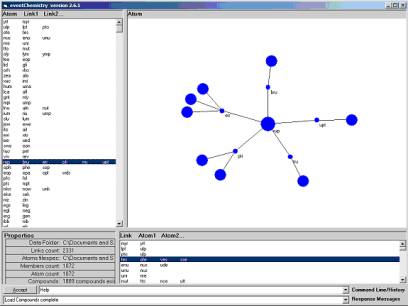
Figure 1: An early control interface over an ontology referential base
Anticipatory
mechanisms natural to human intelligence are given additional support via a set
of computer-encoded invariance and the templates. The anticipatory technology does not treat the computer, or computer
networks, as being the origin of intelligence.
The computer is merely a measurement device.
In an
anticipatory web the nature of computing is placed into a context where natural
science is able to make explicit the limitations that computers have, and not
over step these limitations. This
recognition about limitations has many benefits. First, a mature view of information science is taken.
The maturity is
well deserved. Unlike the first school,
we do not assume that computer programs can know anything. We acknowledge that the computer is not
aware of information and cannot verify if the information is appropriate.
One of the
surprises coming from anticipatory technology has to do with some specific
innovations that simplify data management through a clear understanding about
the relationship between data, information, and the experience of information
as human knowledge. Simple data
encoding innovations support anticipatory technology. These data encoding innovations are fully explained and
illustrative software is available to the reader [19].
History will
record the struggle between the two schools, and the eventual revolution in
information science. The changes that
will accompany this revolution will be profound. The second school provides a distribution of social value and
leads to a restructuring of many of the current university disciplines. For example the importance of computer
science will be diminished in order to make way for a science of knowledge
systems. A National Project to create a
K-12 curriculum for the emerging knowledge sciences has been proposed since
1993 by the BCNGroup [20].
The
introduction of natural science to the design of anticipatory architecture
leads one to bypass what are now perceived as intractable problems with the use
of computers. Cyber security and the
control over information by advertising activities is part of the class of
problems that anticipatory technology is able to bypass.
The reader
should be skeptical, but open to an exposition of results from the natural
sciences and a demonstration of the technology that should be on the market
place by the time this book is published.
The exposition provides a foundation to understanding what natural
science has come to know about things like mental event formation and the
nature of natural language. At the same
time, the technology itself exposes multiple bypasses to difficulties we as a
society have with current information science.
Interest in
complexity and in knowledge representation has grown over the past two decades.
Because of this interest, increasing activity exists in academic scholarship
and in commercial and industrial practices, such as eBusiness, Business Process
Re-engineering and collaborative workspaces.
There are now many related published articles and books in this general
area. They include elements of
marketing, cognitive science, computational sciences, operations research, and
neuropsychology.
The principles
that support anticipatory architecture are scattered about in the literature,
like the pieces of a puzzle. When we
started working on “Knowledge Foundations”,
in 1995, we felt that the pieces of this puzzle might be put together. We had some sense of the difficulties that
are implicit in the interdisciplinary nature of our project. The ten years, 1995 – 2005, have brought to
us a deepening experience of the science and the frustrations caused by
cultural barriers.
The cultural
barriers are merely the tip of the ice berg.
The deeper core cause of dysfunction in IT systems is found in set
theory and logic. The formal
constructions used in computer science are derived from the foundations of
classical set theory. These
constructions do not admit the natural complexity found in natural
systems. Confusions arise when program
managers, policy makers and others, whose decisions have shaped the
computational sciences and commercial applications of computer science, do not
recognize the role that natural complexity must play in the resolution of
information sharing problems.
Our confusion
is related to the nature of abstraction and the formation of language,
mathematics, theories of science and private theories of self. There is no special field of investigation
that looks at confusions of this type and seeks to resolve problems. A science of knowledge systems would have to
take responsibility for confusions that arise and persist. In taking this responsibility, the new
science must turn to principles of objective science and address a complete set
of issues, without political and economic control by hidden interests. The nature of observation and the
relationship that observations have to notational constructions is where the
line of attack, on overly entrenched institutions, must begin. An extension of formal mathematics is
required.
The extension
requires that the process of induction be left (partially) open so that
individual users might determine the meaning of elements of a symbol system at
the last moment, i.e. in real time.
Human memory and anticipatory mechanism provide this last minute
induction to every living system. In a
computer based anticipatory system, knowledge of structure and possible
meanings can be constructed in advance of critical missions that require a
perception of the facts on the ground.
So we are now able to move the kind of intelligence that individuals
have, always, to a collective system where knowledge of invariance and patterns
of invariance allow a collective aggregation of human information production
into a single system.
Natural science
states that mechanisms involved in awareness are not subject to direct human
observation. Stated in a different way, the experience of information by a
human does not at the same time come with an experience of the mechanisms that
cause information to be experienced.
These mechanisms are not observable, and yet private experience is
immediate and complete. The metaphor to
logic and computer processing is attractive but incorrect.
This metaphor
must be replaced. It must be turned on
its head.
The awareness
by a human of a situation is always far more powerful than a dependency on
first order predicate logics will capture.
What is useful is the structural knowledge of how things in the real
world tend to fit together. There is no
inference required, just structural knowledge.
The corrections to computer science are found in sound science that
accounts for direct human observation and for the class of
non-observable causes of events. The
notion of stratification is key, and this notion is developed in the notations
that follow in this chapter.
Stratification
theory suggests that causes outside of those that can be observed. Hidden causation is involved in the final
cause of how something comes into existence.
Stratification theory honors the best science when that science looks at
the complete picture.
The bottom line
is two fold. First, science has just
not gotten to an explanation that is simple enough as yet. Second, our society has fallen into the trap
characterized by the uncritical examination of what is heavily funded by
entrenched institutions. What is funded
is complicated and confused, but is certified as being the best science, in
spite of the fact that the “best science” is defined to be what is best for
those institutions that receive funding.
Shifting the paradigm will allow funding decisions to be based on a
different set of criterion. For
example, individual members of computer science departments will simply shift
their interests towards a more productive activity. Academic entrenchment will be replaced by open and clearly
defined productivity.
The reader is
encouraged examine the claim that various mnemonics are used to reinforce a
false notion of science. A polemic is
developed [21], as
polemics often are, so that terms in social discourse are given a false
meaning. The false meaning is then used
to re-enforce the notion that natural intelligence is not a subject for
scientific inquiry. Many people would
say that religion should be consulted here and not science. These individuals would limit the inquiry
that natural scientists would like to make regarding the nature of life. If science itself remains confused by
disciplines like artificial intelligence, then religious and secular
fundamentalists are successful in their inventions. The polemic works when people are confused about what the academy
says about intelligence.
Beyond the
current political and philosophical tensions, we see a positive economic,
cultural and social revolution. Not
only anticipatory technology but also other forms of knowledge technologies
will soon rapidly transition markets.
How soon? No one can tell. At one point, however, the economic,
political and ideological inhibition aligned against the formation of knowledge
science will collapse. Economic reality
will cause this inhibition to collapse.
Just look
around. Many social and religious
beliefs show concern about a science of knowledge systems. The polemics express this concern and stand
in the way of an economic benefit. On
the other hand, the knowledge sciences can be applied to the solution of
specific social problems, such as those foundational to a modern medicine. Social interests can be stimulated as
knowledge technologies are applied to entertainment and education.
Knowledge
science has applications that enhance the creative expression of
individuals. Within the Internet
communities, new types of software systems are supporting the management of
collective intelligence in communities connected by web technologies. These communities have shared interests
brought together via connectivity in the web.
With the technologies described in this text, one can develop a process
that accurately measures social discourse in real time and differentially tunes
the measurement to specific communities.
The second school suggests the possibilities of a structured
machine based knowledge ontology having no “required” logical inferences and no
proprietary art form. The abstract
constructions of structural ontology have a capacity to participate together
with a human, in manipulation of structure and meaning. We believe that anticipatory software will
be used to "mediate" human discussions, and thus has the potential to
bring web-based discussions to a higher plane.
This higher plane
might be, we have argued, more informed with correct facts, have extensive
scholarly discourse, and allow a type of right size just-in-time distance
learning to be delivered as part of the discourse.
The second school develops a view about potentials that exist
for a new generation of individualized information production tools. These tools are not expected by the markets,
or by the mainstream of computer science.
Anticipatory
technology depends on human cognition to make subtle corrections to the
processes of algorithms. In exchange
for this human touch, the technology opens up the human induction process. Individuals and communities develop symbol
systems that can become empowered with knowledge processing systems, like the
Adi structured abstraction ontology [22],
the Stephenson structured abstraction ontology [23]for
cyber attack mechanisms, or the Ballard knowledge processor [24].
In anticipatory
technology, an action-perception event loop is defined that records certain
parts of decisions made by the human in a fashion that builds two types of
artifact repositories, one related to memory of the invariant aspects of the
past experiences and other related to the environmental conditions. Over time, this artifact library assumes the
role of preserving a memory of text read, messages exchanged and decisions
made. The artifact library is organized
into a structural ontology using the generative methodology that we are working
to establish preliminary knowledge about.
The second school establishes the historical, scientific and
notational foundation preliminary to the exposure of a generative methodology
and its application to specific objects of investigation. The second school focuses on philosophical
viewpoints, notational devices from logics, semiotics and physics, and a review
of the natural sciences as expressed in cognitive neuroscience literatures [25]. Core to this focus is an understanding of
the nature of an induction by a human mind producing an abstract representation
of some aspect of experience. Induction
is core to the phenomena surrounding the experience by humans of language,
mathematics and the formal constructs of science.
The machine
processes cannot know and cannot understand the meanings or the context of
these artifacts. Much like the book,
the computer is a place to put an abstract representation of human
knowledge. The machine can be used to
develop models of anticipated meaning based on the composition of the
invariance produced from measurement. A
validated theory of type becomes available as part of the computational
process. The artifacts are sharable
when the process is revealed in an accessable curriculum. The creation of a simple technology is now
seen to be a function of the average user’s educational experiences.
In the new information science, an individual human manages the abstraction process producing computer-based categorization of a theory of type. The technology does not overly encumber the individual’s own tacit knowledge of situations. The resulting new capability has radically different properties for any of the current generation information technologies. This capability is consistent with any individual’s interest in creative expression.
It is understood that not everyone is interested in
creativity. However, the inability of
institutions to deal with change is often a function of the degree to which
human creativity is discouraged.
Section 3: Use
philosophy
In developing
the knowledge sciences curriculum, some sorting of “facts” has to be made,
since not all of the scholarly literature is equal. Some deep mistakes can be seen, with hindsight. Some voids are present that need to be
filled in.
The most
critical void is in mathematics curriculums and misplaced (under) expectations
made on average students. The
expectation is measured against algebra and the calculus. This measurement of student ability and
interest is very unfortunate and unwise.
We would modify the standard university curriculums to include more
material from the history, foundations and philosophy of mathematics. This new material would justify the
importance of abstraction and place the formation of abstraction in a context
that allows the students to understand that mathematics is but a mere
language.
Most freshman
students have developed an understanding that higher mathematics is meaningless
to them. Due to experiences in school
they have learned that they cannot learn “mathematics”. Central to a new
curriculum will be instructional materials that help young students understand
the nature of abstraction. This means
that freshman college students will re-learn the foundations of arithmetic and
will address intellectually challenging and interesting information about the
induction of the set of integers. The
induction of the integers arises first from the need to have accounting for
purposes of commerce.
The success of
counting numbers set up the grounding of science in a numerical model of
reality. It is here, in spite of the
many successes of modern engineering science, that one may ask questions about
alternative “inductions”. The theory
of ontology formation is foundational to a natural science of complexity. The recommended curriculum first develops
the concepts of arithmetic and then extends, not to algebra, but to upper
ontology such as the ABC ontology [26]
The induction
of abstraction for the purpose of making sense of the world does not have to
involve the numerical model [27]. The induction of geometry is very closely
related to the induction of the integers (see the work on inductive informatics
by Lev Goldfarb [28]). The application of ontology to medical
science and to the social and psychological sciences is what we have not as yet
seen. We first have some work to do
with curriculums.
In a renewed
mathematics and computer science curriculum, elementary mathematics does not
become inaccessible due to a specific set of confusions about the nature of
abstraction. The nature of abstraction,
in the context of an induction of the set of integers is placed in a social and
cultural context. Other forms of
symbolic representation of experience can be demonstrated. In fact, we are able to made presentations
about the induction of knowledge processors.
John Sowa, Richard Ballard and Tom Adi have each developed specific
knowledge processors, which have been available as software systems since the
early 1990s.
In our schools,
the educational system must not elevate engineering above the natural
sciences. High school training in basic
mathematics must lead the student into natural science; not the engineering
sciences, but the natural sciences.
Those students who wish to devote time to engineering must be shown that
cognitive and social problems are not merely a question of good engineering
design.
A theory of cognition
is available in the neural network and genetic algorithm literatures. This work represents a good start. But the literature leaves many basic
questions open and unresolved and continues to be overly mechanistic. This literature is to be supplemented by
scholarship that goes to the basic questions about how human memory, awareness
and anticipation functions as an expression of natural mechanics.
The objective
is a practical one. How does a student
use HIP tools? Can the student be
informed by a deepened understanding of the relevant natural sciences? Given the current curriculums, how can our
children learn a new type of information science; one that is appropriate to
the age in which he or she will live?
How are hard problems in social and cognitive science to be framed?
For example,
human discourse relies critically on the use of a "time lens" to
gather from real-time experience two classes of "subtleties of
meaning" [29]. Anticipatory technology exploits a time lens
based neuro-cognitive process architecture, as discussed in Chapter Four of the
Foundations. The first application of anticipatory
technology was made in 2002 in response to intelligence community needs. A high level decision was made, a decision
that originated in a request from the President, to create a technology that
maps the social discourse in Muslim countries, and to use logics over the
constructions in this map to anticipate Muslim community responses to
Presidential actions and speeches, see Chapter Nine in Foundations.
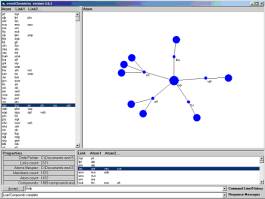

a b
Figure
2: One of the research tools
for Ontology referential bases (Orbs) and the corresponding ontology lens
Prueitt (2002)
invented an ontology lens and the fields of differential ontology and formative
ontology as part of his work on this system.
This technique allows the focus of special graph constructions; called
Ontology referential bases (Orbs), that are formed as a representation of the
co-occurrence of invariance in measured sets, of text with natural language
expressions.
There is very
little political insight into how the lens works in social discourse. So, for example, the social discourse after
the 2004 elections often involved polls whose absence of insight was profound. Long periods of television time are used to
explain away the sense of mismatch between what pollsters have to say and what
people feel and talk about. We saw
these explanations as a reinforcement of the polemic that creates the
impression that the television experts truly understand the opinions of the
American people.
The issue that we are raising in the preface to the Foundations is that the notions necessary to understanding the nature of social discourse is absent in the media representation of the social discourse. The technology that we have developed provides an alternative means to measure the collective need to understand ourselves. The alternative involves a non-numeric, non geometric, induction following a computer-based measurement of co-occurrence patterns in archived text organized in a proper temporal order. The in-correct attribution by some formal logic about the “nearness” of one concept to another concept is not made. These notions about how things are related are left to the individual awareness in real time. The development of informed judgments about what the opinions of the American public are is left un-affected by the mechanisms that support the polemics. The great diversity of opinion is allowed to be manifest without ranking opinions as being acceptable or better than a “mainstream”.
It is not true,
however, that structural ontology supports the development of social
relativism, where there is no truth outside of mere community consensus. Truth finds a deeper expression in
multi-culturalism and the respect for alternative viewpoints that are not those
now controlled by the polemics.
Structural
ontology has three levels, and is stratified in exactly the way we have
represented to be essential to a knowledge technology. Several examples have been developed and is
now available as software. One such
software system, developed and expressed as commercial software by Adi,
measures variations of letter patterns in text. This measurement avoids grammar and semantics of words. From the measurement, a subsetting occurs
within what is in essence a substructural periodic table.
A second layer
of abstraction was constructed to express a theory of natural kind related to
the types of expression that humans need to make. A part of this second layer is triggered by letter patterns. These patterns are measured in a repository
of text using simple algorithms. The
trigger focuses, or subsets, the second layer constructions, resulting in the
production of a representation of the social discourse occurring in that
repository.
This notion of
a time lens is not a question of philosophy but one of empirical observation
and proper use of terminology. The proper terminology suggests that human
experience, and processing, of subtleties of meaning are complementary in
nature and form upper and lower envelops to the coherent packet that is
produced by a "Fourier like transform" of energy distributions
(Pribram, 1991). In our view, the coherent quantum-electric-chemical packet is
formed from the emergence of autonomous systems from a substructure, knowable
as statistical objects, and an ultrastructure, known as context. Quantum, electromagnetic and chemical
processes are involved.
Emergence is
into a middle layer that appears as a complete world to the “thing” that is
created. This may be true because the
process of emergence itself establishes the broad relationships and potential
for relationship as part of the formation process. The physical power of phase coherence is seen in Pribram’s
neurowave equations as a control constraint on the emergence of mental
expressions. We speculate here, of
course. But the idea is that one can
theorize about the nature of coherence in a different way using stratified
theory than one can using the classical theories. Observations about coherence and emergence are placed into
experimental and theoretical frameworks and can be tested.
In our work, a
metaphor to the quantum mechanical view of the natural world is often made,
since atomic phenomenon is known as statistical objects and the chemical
compounds that make up this world are constrained by a set of conservation
laws. We conjecture that these
conservation laws are not “universal” except within an organizational
level. For example, science simply does
not know what the conservation laws are for string phenomenon. This radical conjecture about universal law is
not something that can be proved, as yet, but the alternative cannot be
demonstrated either. As the reader will
see in the Foundations, the conjecture has several corollaries
that apply to a theory of mental event formation.
The second
school suggests that all things that interact within a set of conservation laws
are technically part of the same level of organization. The “knowledge processor” is a computer
encoding of three layers of abstraction.
These three layers of abstraction corresponds to three levels of
organization that cognitive neuroscience tell us .are actually involved in the
functioning of the human brain. The
substructural and ultrastructural levels are organizational abstractions that
we develop as a means to produce the specific constructions within a mew class
of knowledge processors. Notions of
completeness and coherence are to be applied within, but not across, the layers
of organization. The knowledge
processor works by allowing a measurement process to connect with real event
structures. Measurement grounds the
knowledge processor into a pragmatic context only accessable, we suggest, in
the moment. However, the notion of
coherence and completeness can be applied to abstract knowledge
representations, as we know from foundations of mathematics literatures.
In the case of
social discourse the event structure is measured, by algorithmic parsing at a
substructural layer, the language being used.
The middle layer of a structured ontology is also complete in a
technical and observational sense.
Using HIP we place ourselves into this middle level. We produce a measurement of the event
structure in real time. We can see
event structure that is common to our thoughts and the pictorial or graphical
representation of measured invariances.
The magic occurs in the human mind, not in the mythological computer
experience of reality.
The technology
that arises from human-centric information production within the tri-level
architecture is complete observationally, since what can be observed directly
is part of a single reality. But we do
experience the paradoxes familiar in the Lewis Carroll’s Alice in
Wonderland. In classical theory, those
sets of causes that cannot be observed directly, like the contents of someone
else’s introspection, are treated as not part of the “complete world”. The social difficulties that arise, because
of this treatment of the other person, is then “seen” as irrational.
The problems
with coherence do not go away, and in a stratified theory terminological
reconciliation must be accounted for in the “cross organizational scale”
transformations. We have many tools
that address this issue. In Chapters 6
and 7 of the Foundations we will look
at Q-SAR (qualitative structure activity relationship) analysis and the Soviet
era logics called quasi-axiomatic theory.
The appendix reveals a simplication of the Soviet approach to creating
abstraction related to the mechanics of cross scale processes. We also see reconciliation process support
in the knowledge processors revealed within three or four commercial software
systems.
The tri-level
notions make sense to some but not to others.
There is a question of perceptive and in seeing evidence in a specific
light. For example, in the stratified
theory, the two classes of non-observable artifacts, related to memory and
anticipation, each have what the other class does not have. Statistical
artifacts are independent of another.
One has one or one does not. But
the conservation laws come “together” all at once, so to speak and entangle the
output of memory mechanisms with the mechanisms of anticipation. We experience a single awareness of the
world.
This difference
in non-observable classes is due, in part, to the difference in time
scale. The atomic elements, of the
memory mechanism, are categories of occurrences, what we will call
categoricalAbstractions or cA.
Stability over the set of cA atoms is due to the forcing of a
categorical folding that places slightly different elements into crisp
categories. The category replaces the
identity of the individual elements, in an context where the system uses
elements from a category as non-differentiated. This is much like factory workers in a factory. The roles required by the factory dominate
individual differences.
One might
observe that the boundary of a category is sharpened when categories develop
strong relationships with other categories as part of the processes involved in
the formation of compounds. Why would a
category become more crisply defined in those cases where other categories are
developing that have many relationships to the first category? The reasoning as to why seems to me to be self-evident. However, I understand that this
self-evidence is due to my training and knowledge of literatures. Likewise, the environment, in which
composition of atomic element aggregate together, has self-organizing
properties. Compounds only form if there
is a need by the environment that they form, and so only a small number of
possible compounds actually do form. Is
this self-evident to the reader?
Other
fundamentals, like the notion of coherence, are changed in appearance from one
level of organization to another. Because we “live” in the middle world,
coherence is seen as a property of middle world inter-relationships. In the substructure; however, the meaning of
relationship has a different tone than does the meaning of relationship in the
middle level.
Perceptual
memory is of categories of invariance that repeat across multiple
instances. So we encode colors and
textures and re-combine these encoded invariants later into some coherence
packet that we experience as memory. A
color or texture may be inherently harmonic, as perceived aesthetically; but
logical coherence between a specific color and a specific texture is a matter
of an interpretation that has been contextualized. Meaning is established, we conjecture, via the particulars of the
cross scale phenomenon. Meaning
emerges. When an event develops, the
meaning of the event comes with the formation process. After the event has occurred, one can have a
remembrance of the meaning, but that remembrance is an abstraction. Again, is this self-evident to the reader?
We have pointed
out that the neuropsychological literature provides strong evidence that
subtleties of meaning are encoded in biological and environmental medium. We can represent what is encoded as
statistical or categorical artifacts. The use of artifact formalism is useful
in revealing nuances and in developing a representation of what can be
experienced as knowledge by the human.
The structural ontologies are developed from the informed induction of
substructural and ultrastructural invariants.
So in summary;
the tri-level architecture exploits a separation in the physical process
supporting natural intelligence by creating two classes of abstract
artifacts. The lower class of artifacts
is about the substructural invariance in the world and the upper class is about
the non-stationary of the situations in which substructural invariance is
manifest in observables. Natural
intelligence makes this separation, not for arbitrary reasons but because
natural intelligence, unlike artificial intelligence, must depend on actual
physical reality for substance.
So how can this
difference be used in the context of computer based anticipatory
technology? We have suggested that
special knowledge artifacts can be generated and composed into sign
systems. Then the logical atoms of
these systems are developed statistically and assembled into dynamic
categorical policies to represent the discussions of a community.
Because context
is lost in a formalization process, anticipatory technology needs to be based
on a theory of interpretive control and a notational system that provides a
means to express this control. We
suggest that this theory and notation are available to us now.
As one works
through these chapters, and the scholarly citations, the reader should be
prepared for some surprises. The
natural science that we cite will deconstruct some of the polemics of Western
philosophy, in particular logical positivism and scientific reductionism. The natural science forces upon the mathematician
a challenge to extend the notion of induction to symbol systems that are not
solely based on the ancient notion of a number or geometric axiom. As these challenges are recognized, we
reveal a new information science, and a maturing of the natural sciences.